























5 Items
Most primary cells detach within 5-10 min at 37°C. Inactivation isn't required but we recommend to centrifuge the cell suspension to remove accutase and EDTA before replating the cells.
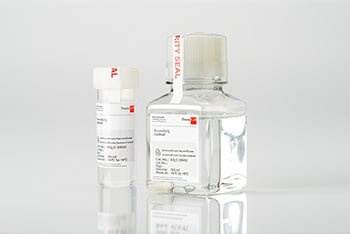
Both trypsin and accutase represent mixtures of different proteolytic enzymes. Trypsin is prepared from porcine pancreas accutase from invertebrates. Accutase can replace trypsin for the detachment and dissociation of anchorage-dependent cells from surfaces and can also be used on suspension cells to reduce clumping in preparation for counting. The advantages of accutase over the traditional trypsin treatment are that it is more gentle and less damaging to cells (leading to increased viability) and does not contain any mammalian or bacterially derived proteins. Accutase is more thermolabile than trypsin and usually doesn't require an inactivation step.
 Accutase Solution
PromoCell_Best-Practices-in-Cell-Culture
Standardized culture of assay-ready and fully functional human primary macrophages
Best Practices for Primary Cell Culture_web
Accutase Solution
PromoCell_Best-Practices-in-Cell-Culture
Standardized culture of assay-ready and fully functional human primary macrophages
Best Practices for Primary Cell Culture_web
- Wash the cells with sterile PBS or HepesBSS
- Add undiluted accutase to the culture vessel (2 ml per 25 cm2)
- Incubate at room temperature for 5-15 min or at 37°C for faster detachment
- When the majority of the cells has detached; centrifuge the suspension and resuspend the pellet in fresh medium. In most cases no additional washes or neutralization steps are required.
Yes you can use accutase to detach Normal Human Cells. Accutase acts very gently on the cells. Cell membranes and surface epitopes will not be harmed. It is therefore mostly used for applications that require unchanged surface markers e.g. for flow cytometry or for detachment of very sensitive cells.
Yes; Accutase Solution can be defrosted; aliquoted; and then refrozen.
Defrosting: Accutase should be defrosted overnight in the refrigerator or placed in a tub of cold tap water. Do not defrost in a 37°C water bath.
Stability: Once thawed; it is stable for at least 2 months in the refrigerator if stored promptly after use.