
Stem cells for regenerative medicine: from tissue repair to therapeutic applications
Stem cells are opening up new regenerative medicine strategies to repair, replace, or restore damaged tissue. From musculoskeletal injuries to hematopoietic reconstitution, stem cell-based approaches are now one of the most active areas of translational medicine. Here, we explore the stem cell types used in regenerative medicine, their roles in tissue repair, and the culture and manufacturing strategies that help move regenerative applications forward.
How do stem cells contribute to tissue repair and regeneration?
Stem cells contribute to tissue repair through three main mechanisms: replacing damaged cells, releasing signaling molecules that influence surrounding cells, and modulating the tissue microenvironment.1,2
- Replacing damaged cells. Stem cells can generate more stem cells and differentiate into various cell types, replacing damaged cells after tissue injury.1
- Releasing regenerative signals. Through paracrine signaling, stem cells secrete growth factors that recruit repair cells and reduce inflammation.3
- Modulating the tissue environment. Stem cells interact with the extracellular matrix, reshaping the tissue microenvironment to promote healing.4
Their self-renewal capacity, differentiation potential, and effects on the tissue microenvironment make stem cells an attractive tool for restoring tissue function in regenerative medicine.
Among adult stem cell populations, mesenchymal stem cells (MSCs) and hematopoietic stem and progenitor cells (HSPCs) are the most widely used in the development of stem cell-based therapies.5
Which stem cell types are used in regenerative medicine?
Researchers have investigated several stem cell populations for regenerative medicine, but MSCs and HSPCs are among the most widely used because of their established therapeutic potential and translational relevance. MSCs and HSPCs play different roles in regenerative medicine. MSCs can promote structural and connective tissue repair, whereas HSPCs can rebuild the blood and immune system.6,7 Together, they account for most of the stem cell therapy regenerative medicine work happening in labs today.5
What mechanisms make MSCs useful for regenerative medicine?
Researchers are investigating MSCs for their tissue-supporting effects, including immunomodulation, paracrine signaling, and potential applications in tissue engineering. Table 1 outlines the therapeutic potential of these effects.
| Mechanism | Physiological role | Therapeutic relevance |
|---|---|---|
| Support repair | Reduce inflammation and recruit local repair | Speeds recovery in wound healing and soft tissue injury |
| Promote regeneration | Reshape the regenerative niche via cell-cell signaling | Used in bone, cartilage, and muscle regeneration |
| Contribute to replacement | Differentiate into osteoblasts, chondrocytes, and similar lineages | Applied in tissue engineering and structural repair |
Table 1. MSC mechanisms and their potential applications in regenerative medicine.
Together, these mechanisms explain the interest in MSCs for regenerative medicine applications, including bone and cartilage repair, wound healing, and tissue engineering.
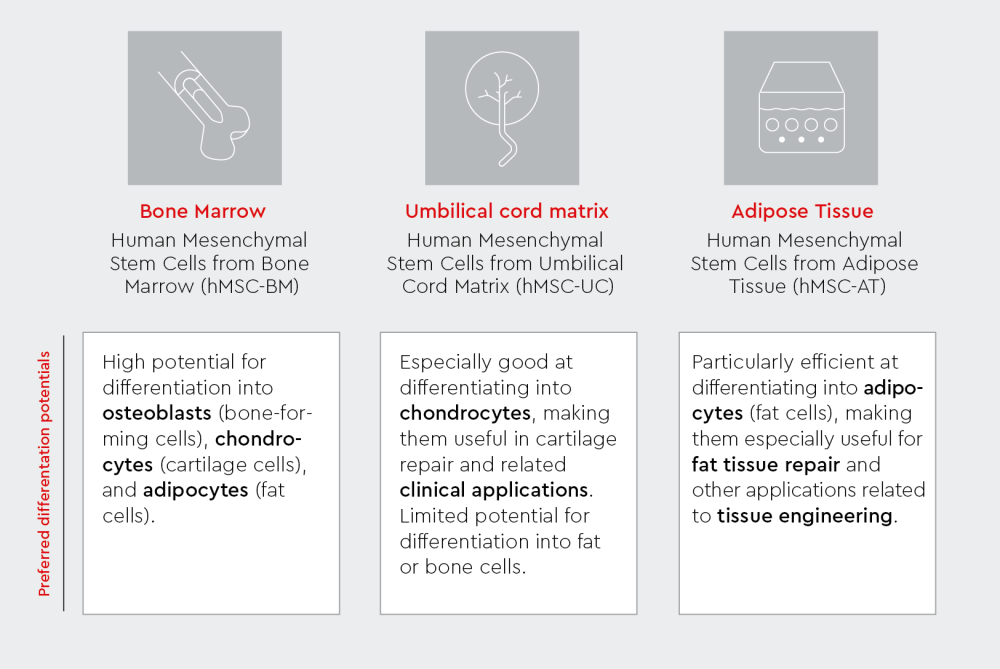
Figure 1. Differentiation potential of human MSCs by tissue source. MSCs from bone marrow, umbilical cord matrix, and adipose tissue differ in their preference for differentiating into osteoblasts, chondrocytes, and adipocytes, which shapes their use in clinical applications and tissue engineering.8–10
Why are MSCs attractive for regenerative medicine?
Several characteristics make MSCs attractive candidates for regenerative medicine research and therapy development:
How are HSPCs used in regenerative medicine?
HSPCs are useful for regenerative medicine applications such as transplantation because they can generate blood cells and immune cells.6,7
| Function | Physiological role | Therapeutic relevance |
|---|---|---|
| Blood cell formation | Generate red cells, white cells, and platelets through hematopoiesis | Restores blood production after bone marrow damage |
| Immune reconstitution | Repopulate immune cell lineages after ablation | Supports recovery after transplantation and chemotherapy |
Table 2. Physiological roles of HSPCs and their therapeutic relevance.
Hematopoietic stem cell transplantation is an established clinical application of stem cells and gives us a foundation for understanding the role of HSPCs in regenerative medicine.14
What challenges remain in translating stem cell research into regenerative therapies?
One of the biggest challenges in regenerative medicine is producing stem cells consistently, at scale, and without losing the properties that make them valuable for tissue repair and regeneration.17–19 In practice, these challenges affect how reliably you can scale up, reproduce results, and predict therapy performance. Challenges in developing stem cell-based regenerative therapies include the following17–19:
- Scalability without losing functionality. Expanding cells to clinical quantities can reduce potency.
- Product consistency. Batch-to-batch variation can lead to differences in marker expression, phenotype, and cellular functionality, making therapy performance hard to predict.
- Cryopreservation. Cells must survive freezing and thawing cycles without losing viability and functionality.
- Quality control. Every batch needs to be tested for quality before release.
- GMP requirements. Clinical-grade manufacturing requires reproducible, documented processes.
- Clinical translation. Preclinical success doesn't always translate to clinical success.
The use of the right culture systems and quality controls can help overcome these challenges, making it easier for stem cell-based regenerative medicine applications to reach the clinic.
How can stem cell challenges be overcome for regenerative medicine applications?
Optimized culture conditions can help you address the challenges of generating stem cells for regenerative medicine applications. Culture media, supplements, and expansion protocols each affect stem cell viability, function, and differentiation.20,21
How can I maintain stem cell potency during expansion?
Stem cell potency depends on keeping cells in a multipotent state.22 Well-characterized cells and optimized expansion media are essential for expansion and scale-up.
Consider the following:
- Monitor self-renewal markers.
- Test multipotency with functional differentiation assays.
- Limit unnecessary passaging.
Our MSC expansion media are low-serum, or serum-free and xeno-free, supporting consistent MSC expansion with less variability between each cell batch production.
Our Human Mesenchymal Stem Cells (hMSC) from different organs are well characterized for clinical applications.
Our Hematopoietic Progenitor Cell Expansion Medium XF supports xeno-free HSPC expansion and yields cells enriched with functional CD34+ progenitor cells.
What media can I use for stem cell differentiation?
Differentiation media direct a stem cell toward a specific lineage.20,21
Our MSC differentiation media support reproducible differentiation into adipogenic, chondrogenic, osteogenic, or neurogenic lineages.
Do I need to use serum-free and xeno-free culture systems?
Serum-free and xeno-free culture systems offer several advantages23,24:
- Reduced variability, helping you avoid the batch inconsistency that animal-derived serum can introduce.
- Improved reproducibility of cell functionality across expansion runs.
- Better patient compatibility, since xeno-free systems lower the risk of immune reactions.
- Easier transition to GMP, since xeno-free media can support your move to GMP manufacturing.
We at PromoCell, offer serum-free, xeno-free media for MSC and HSPC , enabling more consistent and controlled cell culture workflows.
How can I prepare for GMP applications?
Planning the move from research-grade materials to GMP workflows early smooths technology transfer. Our PromoExQ off-the-shelf portfolio offers ready-to-use GMP media for MSC and HSPC expansion, while Custom GMP Services tailor media to your process.
How can I establish robust cryopreservation?
Freeze-thaw stress can affect stem cell viability, recovery, and functionality. Our Freezing Medium Cryo-SFM Plus is a defined, animal component-free medium with antioxidant technology that supports consistent post-thaw recovery. For GMP workflows, PromoExQ CellNAP is a GMP-ready cryopreservation medium.
Progress in regenerative medicine depends on more than stem cell biology. Researchers also need robust culture systems, reproducible expansion strategies, and scalable manufacturing workflows to translate promising discoveries into real-world applications.
Frequently asked questions
References
Expand
- Jin Y, Li S, Yu Q, Chen T, Liu D. (2023). Application of stem cells in regeneration medicine. MedComm., 4(4):e291. doi:10.1002/mco2.291
- Sharifi MA, Yasin NF, Kamarul T, Sharifi AM. (2025). The regenerative journey: exploring stem cell roles from injury detection to tissue repair. Stem Cell Res Ther., 16:541. doi:10.1186/s13287-025-04609-7
- Baraniak PR, McDevitt TC. (2010). Stem cell paracrine actions and tissue regeneration. Regen Med., 5(1):121-143. doi:10.2217/rme.09.74
- Lv S, Wang J, Chen J, et al. (2026). Mesenchymal stem cell-derived extracellular matrix for musculoskeletal tissue regeneration. Commun Biol., 9(1):147. doi:10.1038/s42003-026-09638-3
- Li J, Luanpitpong S, Kheolamai P. (2022). Editorial: Adult stem cells for regenerative medicine: From cell fate to clinical applications. Front Cell Dev Biol., 10:1069665. doi:10.3389/fcell.2022.1069665
- Han X, Liao R, Li X, et al. (2025). Mesenchymal stem cells in treating human diseases: molecular mechanisms and clinical studies. Signal Transduct Target Ther., 10:262. doi:10.1038/s41392-025-02313-9
- Wang Y xiang, Deng Z hua, Li Y yan, et al. (2025). Function of hematopoiesis and bone marrow niche in inflammation and non-hematopoietic diseases. Life Med., 4(3):lnaf015. doi:10.1093/lifemedi/lnaf015
- Al-Nbaheen M, Vishnubalaji R, Ali D, et al. (2013). Human stromal (mesenchymal) stem cells from bone marrow, adipose tissue and skin exhibit differences in molecular phenotype and differentiation potential. Stem Cell Rev Rep., 9(1):32-43. doi:10.1007/s12015-012-9365-8
- Ma J, Wu J, Han L, et al. (2019). Comparative analysis of mesenchymal stem cells derived from amniotic membrane, umbilical cord, and chorionic plate under serum-free condition. Stem Cell Res Ther., 10(1):19. doi:10.1186/s13287-018-1104-x
- Monaco E, Bionaz M, Hollister SJ, Wheeler MB. (2011). Strategies for regeneration of the bone using porcine adult adipose-derived mesenchymal stem cells. Theriogenology., 75(8):1381-1399. doi:10.1016/j.theriogenology.2010.11.020
- Macrin D, Joseph JP, Pillai AA, Devi A. (2017). Eminent sources of adult mesenchymal stem cells and their therapeutic imminence. Stem Cell Rev Rep., 13(6):741-756. doi:10.1007/s12015-017-9759-8
- Thanaskody K, Jusop AS, Tye GJ, Wan Kamarul Zaman WS, Dass SA, Nordin F. (2022). MSCs vs. iPSCs: Potential in therapeutic applications. Front Cell Dev Biol., 10:1005926. doi:10.3389/fcell.2022.1005926
- Hussein M. (2025). Advancing regenerative therapies with umbilical cord-derived mesenchymal stem cells: A review. Biomol Biomed., 26(4):537-546. doi:10.17305/bb.2025.13147
- Scala S, Ferrua F, Basso-Ricci L, et al. (2023). Hematopoietic reconstitution dynamics of mobilized- and bone marrow-derived human hematopoietic stem cells after gene therapy. Nat Commun., 14:3068. doi:10.1038/s41467-023-38448-y
- Müller AM, Huppertz S, Henschler R. (2016). Hematopoietic stem cells in regenerative medicine: astray or on the path? Transfus Med Hemotherapy., 43(4):247-254. doi:10.1159/000447748
- Porada CD, Atala AJ, Almeida-Porada G. (2016). The hematopoietic system in the context of regenerative medicine. Methods., 99:44-61. doi:10.1016/j.ymeth.2015.08.015
- Mayeen NF, Salma U, Abu Kasim NH, Mahmoud O, Haque N. (2025). Hurdles to overcome for mesenchymal stem cell translation from bench to bedside. World J Stem Cells., 17(12):114349. doi:10.4252/wjsc.v17.i12.114349
- Badawy S, Gopinath V, Espinosa AMD, et al. (2025). Tissue regenerative medicine: clinical advances, challenges, and opportunities. APL Bioeng., 9(4):040902. doi:10.1063/5.0296897
- Wei L, Yan W, Shah W, et al. (2024). Advancements and challenges in stem cell transplantation for regenerative medicine. Heliyon., 10(16):e35836. doi:10.1016/j.heliyon.2024.e35836
- Gharibi B, Hughes FJ. (2012). Effects of medium supplements on proliferation, differentiation potential, and in vitro expansion of mesenchymal stem cells. Stem Cells Transl Med., 1(11):771-782. doi:10.5966/sctm.2010-0031
- Riis S, Nielsen FM, Pennisi CP, Zachar V, Fink T. (2016). Comparative analysis of media and supplements on initiation and expansion of adipose-derived stem cells. Stem Cells Transl Med., 5(3):314-324. doi:10.5966/sctm.2015-0148
- Binato R, de Souza Fernandez T, Lazzarotto-Silva C, et al. (2012). Stability of human mesenchymal stem cells during in vitro culture: considerations for cell therapy. Cell Prolif., 46(1):10-22. doi:10.1111/cpr.12002
- Swamynathan P, Venugopal P, Kannan S, et al. (2014). Are serum-free and xeno-free culture conditions ideal for large scale clinical grade expansion of Wharton’s jelly derived mesenchymal stem cells? A comparative study. Stem Cell Res Ther., 5(4):88. doi:10.1186/scrt477
- Hoang VT, Trinh QM, Phuong DTM, et al. (2021). Standardized xeno- and serum-free culture platform enables large-scale expansion of high-quality mesenchymal stem/stromal cells from perinatal and adult tissue sources. Cytotherapy., 23(1):88-99. doi:10.1016/j.jcyt.2020.09.004