
Stem cell potency: types, differentiation, and applications
Stem cell potency refers to the ability of stem cells to give rise to various cell types. It is an important consideration in regenerative medicine, as stem cells vary in their differentiation potential. Selecting the right stem cell population and culture strategy for a specific application can therefore be challenging. Understanding stem cell potency can help guide these decisions.
What is stem cell potency?
Stem cell potency reflects the developmental potential of a stem cell, or the range of cell types that a stem cell can produce.1 This range narrows during development, largely because specific genes switch on or off inside the cell.2,3 Higher potency means broader gene activity, whereas lower potency means more fixed gene expression programs. Stem cell potency is a snapshot of a cell’s genetic flexibility at a given moment.
What are the different types of stem cell potency?
Stem cell potency follows a hierarchy, ranging from unipotent cells that can generate cells of a single lineage (e.g., an epidermal stem cell that can only give rise to more skin cells) to totipotent cells that can give rise to an entire organism (e.g., a fertilized egg capable of giving rise to an entire organism).1,4 Table 1 provides examples of all the different levels of stem cell potency.
| Hierarchy | Potency type | Differentiation capacity | Example |
|---|---|---|---|
| 1 (highest) | Totipotent | All cell types, plus extraembryonic tissue | Zygote |
| 2 | Pluripotent | All body cell types | Embryonic stem cells (ESCs), induced pluripotent stem cells (iPSCs) |
| 3 | Multipotent | Multiple related lineages | Mesenchymal stem cells (MSCs), hematopoietic stem cells (HSCs) |
| 4 | Oligopotent | A few related lineages | Myeloid progenitor cells, hematopoietic progenitor cells (HPCs) |
| 5 (lowest) | Unipotent | A single lineage | Skin stem cells, fully commited HPCs |
Table 1: Hierarchy of stem cell potency1,4
The main difference between potency levels is the number of cell lineages each stem cell can generate.
Totipotent cells exist only in the earliest stages of life, right after fertilization.5 Pluripotent cells, including embryonic stem cells and induced pluripotent stem cells, lose the ability to form a placenta but can still generate nearly every tissue in the body.5 Multipotent cells, such as mesenchymal stem cells (MSCs) and hematopoietic stem cells, further specialize into related cell lineages.6 Oligopotent cells can give rise to only a few related lineages, and unipotent stem cells commit to a single lineage, such as the cells that continuously replace your skin.7
Are stem cell potency and differentiation the same?
No. Stem cell potency and differentiation are related concepts, but they are not the same. Stem cell potency is a cell’s differentiation potential, whereas differentiation is the process by which cells use that potential to generate other cell types.8 Potency is also closely linked to cellular plasticity, or the ability of cells to adopt different identities.
Another key property of stem cells is self-renewal, which refers to their ability to produce identical daughter stem cells while maintaining their potency.9
How does stem cell differentiation relate to potency?
Potency decreases as cells differentiate and become more specialized.1,8 Changes in gene expression contribute to lineage commitment during cell differentiation.2,3 Typically, a pluripotent cell that differentiates into a neuron can no longer differentiate into a muscle cell or blood cell. But in the lab, researchers can induce pluripotency in adult cells by reprogramming them back to an embryonic-like state, creating induced pluripotent stem cells (iPSCs).10 MSCs can differentiate into different lineages depending on their tissue of origin. However, their potency becomes progressively restricted as they commit to specific cell fates.11 Similarly, hematopoietic stem and progenitor cells (HSPCs) differentiate along myeloid or lymphoid lineages, ultimately giving rise to specialized blood and immune cells.12
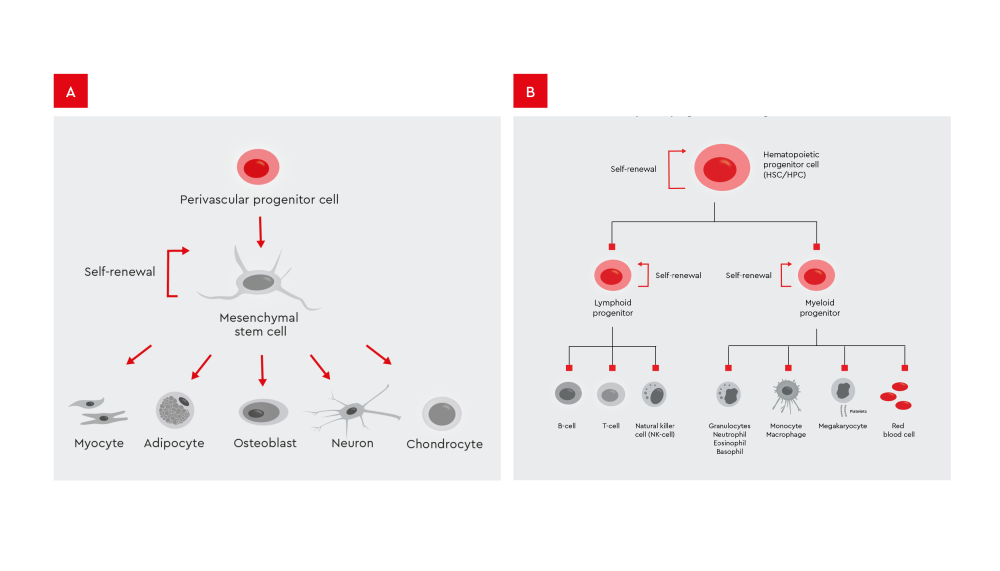
Figure 1: Lineage potential of mesenchymal stromal cells (MSCs) and CD34+ hematopoietic stem and progenitor cells (HSPCs). (A) MSCs can self-renew and differentiate into multiple cell lineages. (B) CD34+ HSPCs can differentiate along myeloid and lymphoid lineages to generate blood and immune cells.
What regulates stem cell potency and differentiation?
Two categories of signals regulate stemness, including stem cell potency, cell fate, and differentiation.
Intrinsic factors (signals from inside the cell)13,14:
- Gene expression patterns that switch potency-related genes on or off
- Epigenetic marks that lock certain genes into an active or silent state
Extrinsic factors (signals from the cell’s environment)15,16:
- Growth factors and cytokines that signal a cell to specialize
- The extracellular matrix, oxygen levels, and physical cues from neighboring cells and matrix
Signals from both inside and outside cells influence the sets of genes a given cell expresses, thereby contributing to lineage commitment and cell differentiation.4,17
That’s why cell culture conditions are so important in stem cell research. Suboptimal culture conditions can alter gene expression, reduce stem cell potency, or bias differentiation toward unintended cell lineages. If culture conditions, including culture media, are not optimal for your specific cell type, stem cells can drift toward the wrong cell fate or fail to differentiate.
Why is stem cell potency important in research and therapy?
Stem cell potency sits at the center of regenerative medicine, disease modeling, and drug discovery.18,19 Researchers need to know what stem cells can become and how to induce their differentiation into a specific cell type before using them for research or therapeutic applications.
For example, pluripotent stem cells can generate various cell types and are commonly used in research applications such as organoid development and disease modeling.18,19 Multipotent and oligopotent stem cells, including MSCs and HSPCs, are valuable for translational research and clinical applications.20,21 In fact both cell types have shown significant therapeutic promise across a range of diseases.
What is the therapeutic potential of MSCs and HSPCs
MSCs have shown therapeutic potential in various conditions, largely because of their immunomodulatory and regenerative properties. They are being investigated for graft-versus-host disease, osteoarthritis and cartilage repair, wound healing, and other conditions involving inflammation or tissue damage.22 MSC-derived extracellular vesicles (EVs) are also being explored as delivery vehicles for targeted therapeutics.23 HSPCs are the foundation of hematopoietic stem cell transplantation, restoring blood and immune cell production in patients with leukemia, lymphoma, and other hematologic disorders.24
Despite this promise, realizing the full potential of MSCs and HSPCs depends on maintaining consistent cell quality, robust characterization, and optimized culture conditions. A protocol that works once in a dish doesn’t always work in a bioreactor. Even small batch-to-batch differences can affect differentiation outcomes. Standardized culture systems are critical for generating reproducible and scalable results in both research and translational applications.
Practical tookit: stem cell culture and differentiation solutions
Reliable stem cell research depends on robust potency assessment, optimized culture conditions, and controlled differentiation protocols. Achieving these goals requires high-quality stem cells, properly formulated differentiation inducers, and low-serum, serum-free, or xeno-free growth media.
We support stem cell research by offering:
- Human mesenchymal stem cells (hMSC) from various tissue sources
- Optimized growth media for standardized expansion of multipotent Human mesenchymal stem cells (hMSC)
- Controlled differentiation solutions for the efficient induction of MSCs into adipogenic, chondrogenic, osteogenic, or neurogenic lineages
- Optimized growth media for HPCs that enable cell expansion while helping preserve functional progenitor cell population
Browse the full range of stem cell products for cells and media matched to your potency level, including GMP MSC media through the PromoExQ off-the-shelf portfolio.
FAQs
References
Expand
- Singh VK, Saini A, Kalsan M, Kumar N, Chandra R. (2016). Describing the stem cell potency: the various methods of functional assessment and in silico diagnostics. Front Cell Dev Biol., 4. doi:10.3389/fcell.2016.00134
- Biondo M, Cirone N, Valle F, Lazzardi S, Caselle M, Osella M. (2025). The intrinsic dimension of gene expression during cell differentiation. Nucleic Acids Res., 53(16):gkaf805. doi:10.1093/nar/gkaf805
- Hemberger M, Dean W, Reik W. (2009). Epigenetic dynamics of stem cells and cell lineage commitment: digging Waddington’s canal. Nat Rev Mol Cell Biol., 10(8):526-537. doi:10.1038/nrm2727
- Beumer J, Clevers H. (2024). Hallmarks of stemness in mammalian tissues. Cell Stem Cell., 31(1):7-24. doi:10.1016/j.stem.2023.12.006
- Du P, Wu J. (2024). Hallmarks of totipotent and pluripotent stem cell states. Cell Stem Cell., 31(3):312-333. doi:10.1016/j.stem.2024.01.009
- Aprile D, Patrone D, Peluso G, Galderisi U. (2024). Multipotent/pluripotent stem cell populations in stromal tissues and peripheral blood: exploring diversity, potential, and therapeutic applications. Stem Cell Res Ther., 15(1):139. doi:10.1186/s13287-024-03752-x
- Notta F, Zandi S, Takayama N, et al. (2016). Distinct routes of lineage development reshape the human blood hierarchy across ontogeny. Science., 351(6269):aab2116. doi:10.1126/science.aab2116
- Pittenger MF, Kerr CL. (2023). Stem cells. In: Tissue Engineering. Elsevier; 2023:13-69. doi:10.1016/B978-0-12-824459-3.00002-0
- Shenghui H, Nakada D, Morrison SJ. (2009). Mechanisms of stem cell self-renewal. Annu Rev Cell Dev Biol., 25(1):377-406. doi:10.1146/annurev.cellbio.042308.113248
- Stadtfeld M, Hochedlinger K. (2010). Induced pluripotency: history, mechanisms, and applications. Genes Dev., 24(20):2239-2263. doi:10.1101/gad.1963910
- Robey PG. (2017). “Mesenchymal stem cells”: fact or fiction, and implications in their therapeutic use. F1000Research., 6:524. doi:10.12688/f1000research.10955.1
- Weiskopf K, Schnorr PJ, Pang WW, et al. (2016). Myeloid cell origins, differentiation, and clinical implications. Gordon S, ed. Microbiol Spectr., 4(5):4.5.21. doi:10.1128/microbiolspec.MCHD-0031-2016
- Coskun V, Tsoa R, Sun YE. (2012). Epigenetic regulation of stem cells differentiating along the neural lineage. Curr Opin Neurobiol., 22(5):762-767. doi:10.1016/j.conb.2012.07.001
- Perez-Campo F, Riancho J. (2015). Epigenetic mechanisms regulating mesenchymal stem cell differentiation. Curr Genomics., 16(6):368-383. doi:10.2174/1389202916666150817202559
- Discher DE, Mooney DJ, Zandstra PW. (2009). Growth factors, matrices, and forces combine and control stem cells. Science., 324(5935):1673-1677. doi:10.1126/science.1171643
- Zhao T, Huang Y, Zhu J, et al. (2025). Extracellular matrix signaling cues: biological functions, diseases, and therapeutic targets. MedComm., 6(8):e70281. doi:10.1002/mco2.70281
- Enver T, Pera M, Peterson C, Andrews PW. (2009). Stem cell states, fates, and the rules of attraction. Cell Stem Cell., 4(5):387-397. doi:10.1016/j.stem.2009.04.011
- Singh VK, Kalsan M, Kumar N, Saini A, Chandra R. (2015). Induced pluripotent stem cells: applications in regenerative medicine, disease modeling, and drug discovery. Front Cell Dev Biol., 3. doi:10.3389/fcell.2015.00002
- O’Connor KC, Stanley HJ, Bunnell BA, De Caro R. (2025). Editorial: Role of induced pluripotent stem cells (iPSCs) in regenerative medicine, disease modeling and drug discovery. Front Bioeng Biotechnol., 13:1734717. doi:10.3389/fbioe.2025.1734717
- Zhao X, Ming X, Wu J, Zhu X, Xiao Y. (2026). Mesenchymal stromal cells: bridging the gaps in hematologic disease therapy. Stem Cell Rev Rep., 22(1):434-488. doi:10.1007/s12015-025-11011-6
- Bujko K, Kucia M, Ratajczak J, Ratajczak MZ. (2019). Hematopoietic stem and progenitor cells (HSPCs). In: Ratajczak MZ, ed. Stem Cells. Vol 1201. Advances in Experimental Medicine and Biology. Springer International Publishing; 2019:49-77. doi:10.1007/978-3-030-31206-0_3
- Wu X, Jiang J, Gu Z, Zhang J, Chen Y, Liu X. (2020). Mesenchymal stromal cell therapies: immunomodulatory properties and clinical progress. Stem Cell Res Ther., 11(1):345. doi:10.1186/s13287-020-01855-9
- Shi J, Zhao YC, Niu ZF, et al. (2021). Mesenchymal stem cell-derived small extracellular vesicles in the treatment of human diseases: Progress and prospect. World J Stem Cells., 13(1):49-63. doi:10.4252/wjsc.v13.i1.49
- Lee JY, Hong SH. (2019). Hematopoietic stem cells and their roles in tissue regeneration. Int J Stem Cells., 13(1):1-12. doi:10.15283/ijsc19127
- Han X, Liao R, Li X, et al. (2025). Mesenchymal stem cells in treating human diseases: molecular mechanisms and clinical studies. Signal Transduct Target Ther., 10(1):262. doi:10.1038/s41392-025-02313-9