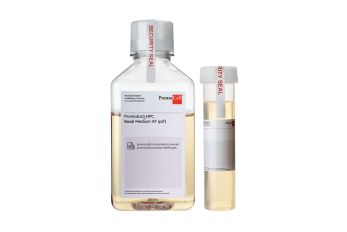
Save more with Cell KITs - Primary cells and recommended media together at a discounted price.

Explore our products

Choose your region

CD34+ HSPC expansion and culture: methods, conditions, and optimization

Reliable expansion of CD34⁺ hematopoietic stem and progenitor cells (HSPCs) in in vitro culture is essential when you’re developing cell and gene therapy applications.

CD34⁺ HSPCs generate all mature blood and immune cells, making them an important tool for cell and gene therapy. Hematopoietic progenitor cells (HPCs), a key HSPC subset, drive downstream differentiation. Expanding these cells outside the body can be challenging. Donor variability, undefined serum components, and differentiation pressure during culture can make it challenging to reliably expand HSPCs in vitro.
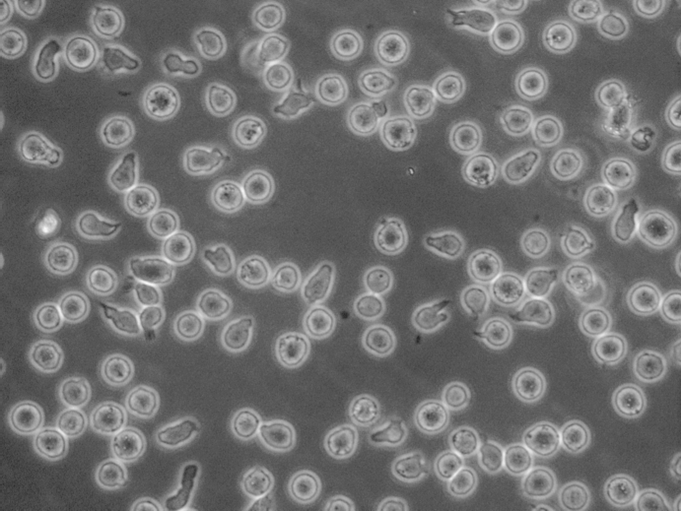
HSPCs cultureHSPCs culture

How are CD34⁺ hematopoietic stem and progenitor cells isolated?

You can isolate CD34⁺ HSPCs from mobilized peripheral blood, bone marrow, and cord blood. Each source has a different frequency and expansion potential of CD34⁺ cells, making baseline cell characterization essential.1–3 

A typical isolation workflow includes:

  1. Collection from your source of choice (bone marrow, cord blood, or mobilized peripheral blood)
  2. Pre-processing via density gradient separation to remove red blood cells and debris
  3. Immunomagnetic CD34⁺ selection to enrich for HSPCs by positive selection for CD34⁺ surface expression4,5

Standardizing these steps early reduces variability in downstream expansion.

CD34⁺ stem and hematopoietic progenitor cell expansion: Why and how?

Native cell sources rarely yield enough CD34⁺ HSPCs for therapeutic or research use. In vitro cell expansion helps you overcome this bottleneck. Expansion helps you increase the number of CD34+ HSPCs without driving differentiation.

To expand CD34⁺ HSPCs, seed cells at a defined density and culture them with cytokines that promote proliferation.6 TPO, SCF, FLT 3 ligand, and IL 3 are commonly used to support the expansion of HPCs.  CD34+ HSPC expansion typically requires frequent medium changes and fed-batch culture.7 These approaches help reduce the accumulation of inhibitory factors secreted by differentiating cells.

Looking for a defined medium optimized for HPC expansion?
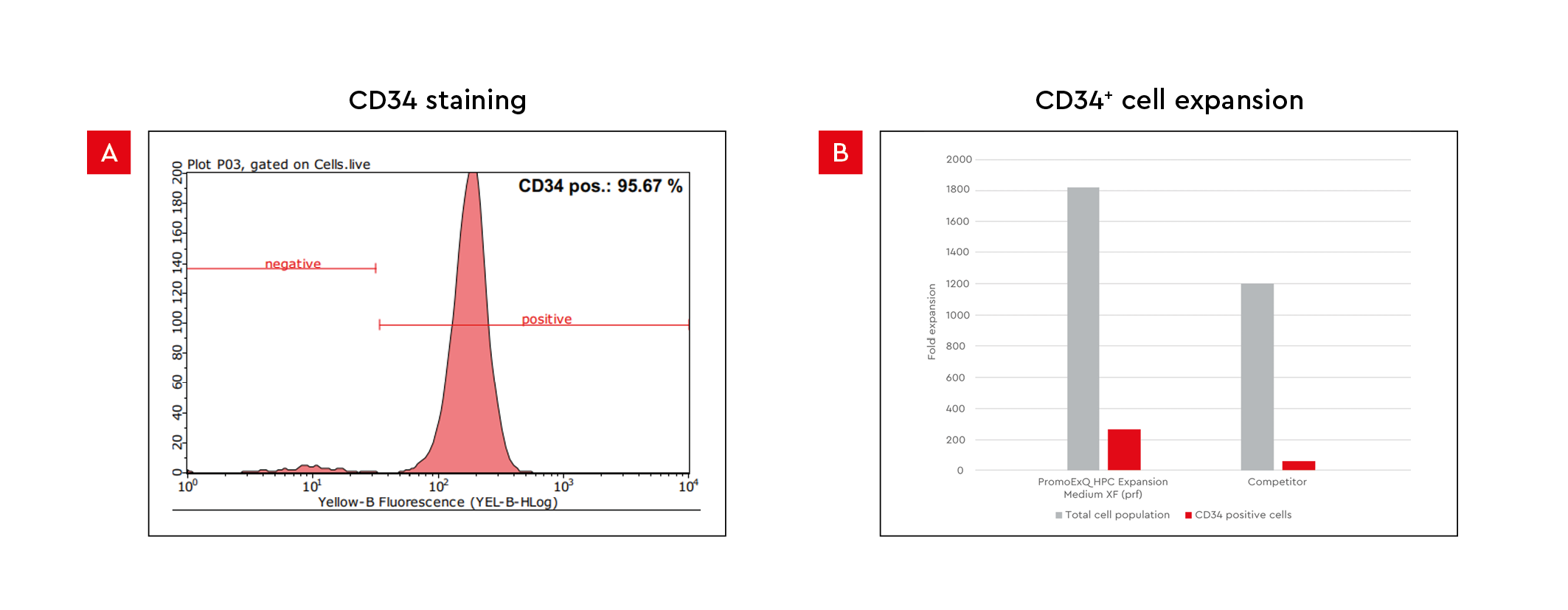
Figure 1: CD34⁺ HPC expansion in culture. A) The figure shows flow cytometry analysis of our CD34+ progenitor cells on day 0 of culture. B) Representative data of the expansion of human cord blood CD34+ cells after 13 days of culture. Cells were expanded using the HPC Expansion Medium XF or competitor medium.

Which variables influence CD34⁺ HSPC expansion quality? 

Each variable in your HSPC expansion protocol can influence the quality of your CD34+ cells. The table below summarizes the variables that determine expansion quality, why each one matters, and what to measure or record as evidence.

Variable Impact on CD34+ expansion Recommended action
Starting cell source and donor variability8,9 Affects expansion potential and baseline phenotype Record donor/source; set acceptance criteria for viability and %CD34 pre-culture
Medium format (serum-containing vs serum-free [SF]/xeno-free [XF] Undefined serum components can increase variability and differentiation pressure Use SF/XF where possible; document lot strategy and comparability readouts
Cytokine supplementation strategy9 Controls proliferation vs differentiation balance Define cytokine mix and timing; track fold expansion and %CD34 retention
Culture density and duration6 Impacts nutrient availability and lineage skew Standardize seeding density; track viability, %CD34, and output cell counts at fixed timepoints
Functional output (e.g., Colony-Forming Unit [CFU] assay)10 Provides evidence of progenitor proliferation and lineage potential Run CFU as a periodic check; record colony types/counts using consistent scoring rules

Table 1: Variables influencing HSPC expansion quality.

These variables shape the functional composition of the expanded population, including the proportion and performance of HPCs required for downstream applications. Control them from the start to avoid compatibility issues, especially if you change medium format mid-study.

How do serum‑free, xeno‑free media support translational workflows?

Serum introduces undefined variables into your HSPC culture. Growth factor concentrations, lipid profiles, and contaminants vary between lots, and that variability affects your downstream results.11

Defined, serum-free media overcome these variations, offering several advantages over serum-containing media:

  • Improved reproducibility because the culture environment is consistent between batches.
  • Reduced differentiation pressure when there are no undefined serum factors to interfere with cytokine signaling.
  • Cleaner regulatory documentation as there are no animal-derived components to track or justify.
  • More interpretable cytokine dose-response studies because you know what's in the medium.
  • Reduced risk of contamination, since the absence of undefined or animal-derived components eliminates a common source of biological variability and infection risk.

How do serum‑free, xeno‑free media support translational workflows?

The bar in CD34⁺ HSPC expansion for therapy development is much higher than that for research. Compared to research applications, therapeutic use requires:

  • Higher reproducibility: Batch-to-batch variation in expanded CD34⁺ hematopoietic progenitor cells can translate into variable engraftment outcomes.12,13 As a cell therapy developer, you need expansion workflows that behave predictably regardless of donor lot.
  • Strict phenotype retention: Phenotype retention is also important because not all CD34⁺ cells are the same. Primitive HSPCs (those that retain long-term repopulating potential) are the most valuable in cell therapy development. Standard flow cytometry markers (CD34, CD90, CD133, CD45RA) give a phenotypic readout, but you need functional assays to confirm engraftment capacity.14,15

CD34⁺ HSPC differentiation enables multiple downstream applications, including production of the following:

  • Red blood cells (RBCs) for transfusion research16
  • Megakaryocytes and platelets  for platelet transfusion research17
  • Dendritic cells and NK cells for immunotherapy18,19
  • Gene-corrected cell products for monogenic diseases20

Getting the most from these applications means building an expansion workflow that is scalable, from early research through to further manufacturing.

How to scale CD34+ HSPC expansion from research to GMP-ready manufacturing? 

There are three stages to moving CD34⁺ HSPC expansion from a research setting toward a more regulated environment.

Benchmark

Establish baseline expansion performance using your cell source of choice.

  • Define baseline conditions: Document donor variability, seeding density, and cytokine concentration.
  • Track performance metrics: Measure expansion fold and %CD34 retention.
  • Capture functional output: Run CFU assays and phenotyping to capture functional data at baseline.

Optimize

Use defined media solutions to improve consistency and reduce variability.

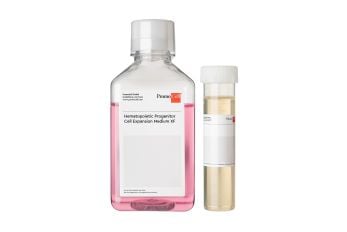
  • Serum-free, xeno-free formulations, such as our Hematopoietic Progenitor Cell Expansion Medium XF, support expansion of hemtapoietic progenitor cells under defined conditions.
  • Fine-tune cytokine supplementation to balance proliferation and phenotype retention.
  • Revisit seeding density and feeding intervals based on your benchmarking data.

Prepare for translation

Align your workflow with regulatory expecations before scale-up.

  • Choose fit-for-purpose reagents: Our PromoExQ HPC Epxansion Medium XF is formulated to support workflows moving toward regulated environments, with Excipient GMP-greade* status and full documentation support.
  • Build your process characterization package: Compile donor variability data, lot strategy, and comparability readouts.
  • Plan for traceability: Ensure every reagent and process step is documented.

*“GMP-grade” is a branding term used by PromoCell to denote reagents that are manufactured at the PromoCell manufacturing facility in Heidelberg, Germany, under strictly controlled processes to meet stringent product specifications and customer requirements. Reagents manufactured at PromoCell are produced according to EXCiPACT™ GMP standards, a quality management system that builds on our ISO 9001:2015 certification. Risk assessment procedures are carried out at the customer site.

Ready to optimize your HSPC expansion?

Improve expansion consistency, support phenotype retention, and reduce variability with media solutions tailored to your application and cell source.

Request customized media for your needs

FAQs

Use defined serum-free media, optimize cytokine concentrations, keep cell density low, and monitor CD34 retention regularly. Frequent medium changes can also reduce the accumulation of inhibitory factors.6,8,9
Serum is undefined. Growth factor content varies between lots, which can unpredictably change your cells' behavior.11 Switching to SF/XF media removes this variable, making lot-to-lot comparisons feasible.
Flow cytometry provides phenotypic data, but CFU assays assess functional potential, including proliferation and lineage differentiation. Use both for a complete picture of expansion quality and apply them throughout the process—not just at the endpoint.21
Monitor the percentage of CD34 before and after expansion, total fold expansion, viability, CFU data (colony types and counts), and cytokine conditions.21 These form your baseline process characterization package.

References

Expand
  1. De Bruyn C, Delforge A, Lagneaux L, Bron D. Characterization of CD34+ subsets derived from bone marrow, umbilical cord blood and mobilized peripheral blood after stem cell factor and interleukin 3 stimulation. Bone Marrow Transplant. 2000;25(4):377-383. doi:10.1038/sj.bmt.1702145
  2. Forte D, Sollazzo D, Barone M, et al. Mobilized peripheral blood versus cord blood: Insight into the distinct role of proinflammatory cytokines on survival, clonogenic ability, and migration of CD34+ cells. Mediators Inflamm. 2018;2018:1-14. doi:10.1155/2018/5974613
  3. Scala S, Ferrua F, Basso-Ricci L, et al. Hematopoietic reconstitution dynamics of mobilized- and bone marrow-derived human hematopoietic stem cells after gene therapy. Nat Commun. 2023;14(1):3068. doi:10.1038/s41467-023-38448-y
  4. Smeland EB, Funderud S, Kvalheim G, Egeland T. Isolation and characterization of human hematopoietic progenitor cells: a method for positive selection of CD34+ cells. Int J Cell Cloning. 1992;10(Suppl 1):845-852.
  5. Avecilla ST, Goss C, Bleau S, Tonon J, Meagher RC. How do I perform hematopoietic progenitor cell selection? Transfusion (Paris). 2016;56(5):1008-1012. doi:10.1111/trf.13534
  6. Eliosa-García V, Flores-Guzmán P, Muñiz-Rivera-Cambas A, Flores-Alday I, Mayani H. Initial cell seeding density in culture influences hematopoietic stem and progenitor cell proliferation, expansion and differentiation. Arch Med Res. 2026;57(5):103402. doi:10.1016/j.arcmed.2026.103402
  7. Flores-Guzmán P, Gutiérrez-Rodríguez M, Mayani H. In vitro proliferation, expansion, and differentiation of a CD34+ cell-enriched hematopoietic cell population from human umbilical cord blood in response to recombinant cytokines. Arch Med Res. 2002;33(2):107-114. doi:10.1016/S0188-4409(01)00368-X
  8. Expansion of haematopoietic stem and progenitor cells: paving the way for next-generation haematopoietic stem cell transplantation. Blood Cell Ther. 2019;2(4). doi:10.31547/bct-2019-004
  9. Walasek MA, Van Os R, De Haan G. Hematopoietic stem cell expansion: challenges and opportunities. Ann N Y Acad Sci. 2012;1266(1):138-150. doi:10.1111/j.1749-6632.2012.06549.x
  10. Rodriguez Y Baena A, Manso BA, Forsberg EC. CFU-S assay: a historical single-cell assay that offers modern insight into clonal hematopoiesis. Exp Hematol. 2021;104:1-8. doi:10.1016/j.exphem.2021.10.003
  11. Weber T, Malakpour-Permlid A, Chary A, et al. Fetal bovine serum: how to leave it behind in the pursuit of more reliable science. Front Toxicol. 2025;7:1612903. doi:10.3389/ftox.2025.1612903
  12. Du Z, Jin H, Cai H, Yang S, Tan W song. Hematopoietic repopulating ability of CD34+ progenitor cells ex vivo expanded with different cytokine combinations. Artif Cells Nanomed Biotechnol. 2015;43(6):398-402. doi:10.3109/21691401.2014.897630
  13. Chung H, Kook HW, Cho H, Jang JE, Cheong JW. Impact of CD34+ cell dose on outcomes of haploidentical peripheral blood stem cell transplantation in acute leukemia. Blood Res. 2025;60(1):42. doi:10.1007/s44313-025-00091-5
  14. Frisch BJ, Calvi LM. Hematopoietic stem cell cultures and assays. In: Hilton MJ, ed. Skeletal Development and Repair. Methods Mol Biol. 2014:315-324. doi:10.1007/978-1-62703-989-5_24
  15. Ema H, Sudo K, Seita J, et al. Quantification of self-renewal capacity in single hematopoietic stem cells from normal and Lnk-deficient mice. Dev Cell. 2005;8(6):907-914. doi:10.1016/j.devcel.2005.03.019
  16. Jin H, Kim HS, Kim S, Kim HO. Erythropoietic potential of CD34+ hematopoietic stem cells from human cord blood and G-CSF-mobilized peripheral blood. BioMed Res Int. 2014;2014:1-9. doi:10.1155/2014/435215
  17. Perdomo J, Yan F, Leung HHL, Chong BH. Megakaryocyte differentiation and platelet formation from human cord blood-derived CD34+ cells. J Vis Exp. 2017;(130):56420. doi:10.3791/56420
  18. Bontkes HJ, De Gruijl TD, Schuurhuis GJ, Scheper RJ, Meijer CJLM, Hooijberg E. Expansion of dendritic cell precursors from human CD34+ progenitor cells isolated from healthy donor blood; growth factor combination determines proliferation rate and functional outcome. J Leukoc Biol. 2002;72(2):321-329.
  19. Bozzano F, Perrone C, Moretta L, De Maria A. NK cell precursors in human bone marrow in health and inflammation. Front Immunol. 2019;10:2045. doi:10.3389/fimmu.2019.02045
  20. Liang M, Pariente N, Morizono K, Chen ISY. Targeted transduction of CD34+ hematopoietic progenitor cells in nonpurified human mobilized peripheral blood mononuclear cells. J Gene Med. 2009;11(3):185-196. doi:10.1002/jgm.1290
  21. Haylock DN, To LB, Dowse T, Juttner CA, Simmons PJ. Ex vivo expansion and maturation of peripheral blood CD34+ cells into the myeloid lineage. Blood. 1992;80(6):1405-1412. doi:10.1182/blood.V80.6.1405.1405

PromoCell uses HubSpot to provide LiveChat support. This feature is currently blocked due to your cookie preferences.

Accept cookies to enable LiveChat