






Cardiac regeneration: from cell models to therapeutic strategies
This eBook brings together research insights and practical guidance to help you explore cardiac regeneration from disease modeling through to emerging therapeutic strategies.
Cardiovascular diseases can cause irreversible tissue damage, yet the heart has a limited capacity to regenerate. For researchers, the challenge is not only to develop new strategies for cardiac repair, but also to select human-relevant models and technologies that can generate meaningful, translational insights.
What you'll learn:
- How 3D cardiac spheroids compare with traditional 2D cultures
- How to perform and analyze an endothelial tube formation assay for in vitro angiogenesis studies
- Why primary human cardiovascular cells are relevant for human cardiac models
- Which design criteria, biomaterials, and fabrication methods are being explored for cardiac patches
- The advances, limitations, and prospects of mesenchymal and induced pluripotent stem cells for cardiac repair
- How hydrogel scaffolds and natural extracellular matrix components are being investigated for cardiac regeneration
This eBook was made in collaboration with RegMedNet.
Download the ebook
Fill in the form to download the PDF.
Related resources
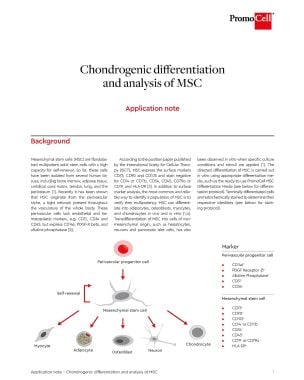
Chondrogenic differentiation and analysis of mesenchymal stem cells (MSC)
Managed in vitro differentiation of mesenchymal stem cells (MSC) into chondrocytes. Multipotent adult stem cells are important for various tissues of the musculoskeletal system.
Application Note

Adipogenic differentiation of mesenchymal stem cells: A complete protocol with Oil Red O staining
Turning mesenchymal stem cells (MSCs) into adipocytes is the focus of this application note, providing a clear and reliable protocol for adipogenic differentiation and analysis.
Application Note
Xeno-free MSC culture: high yield, better viability and morphology
Are you trying to mimic in vivo conditions in your MSC cultures as closely as possible, but need to avoid serum? Then find out how the combination of PromoCell DXF medium and a unique coating called myMATRIX help you make your conditions highly physiological while maintaining reproducibility.
Application Note
MSC cultivation in single-use stirred tank bioreactors
MSCs have gained significant attention because of their therapeutic potential for many difficult-to-treat diseases. In this app note, we provide a protocol for (GMP) compliant large-scale production of MSCs in a single-use bioreactor using our MSC Growth Medium XF.
Application Note

Mesenchymal stem cells: why optimizing manufacturing processes is key for a successful application
Discover the reasons why an optimized manufacturing process is essential for successful application of mesenchymal stem cells.
Application Note

The immunomodulatory properties of mesenchymal stem cells (MSCs)
Since their discovery in 1991, mesenchymal stem cells, or MSCs, have been used as a promising method to build tissue. However, MSCs can do more for the development of cell and gene therapies. Find out more in our video.
Application Note

MSC reproducibility: Towards the standardization of Mesenchymal Stem Cells
For science to move forwards, the research we do must be reproducible. One of the ways we’re helping your work be as consistent as possible is through our characterized MSCs.
Application Note

Mesenchymal stem cell types
Discover our broad range of human mesenchymal stem cells (hMSC), available from bone marrow, adipose tissue and umbilical cord matrix of individual donors. Specific donor information like age, sex and tissue location is available for each produced lot.
Application Note

Characterization of mesenchymal stem cells – why culture conditions and cell identity matter
Learn more about how uniform characterization of MSCs can be applied for improving culture performance and research progress.
Application Note
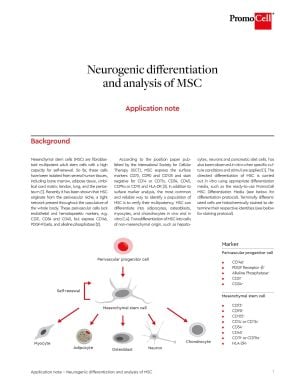
Neurogenic differentiation and analysis of mesenchymal stem cells (MSC)
Specific culture conditions allow for transdifferentiation of mesenchymal stem cells (MSC) into cells of non-mesenchymal origin such as neurons. To do so, specific culture conditions and stimuli are needed.
Application Note
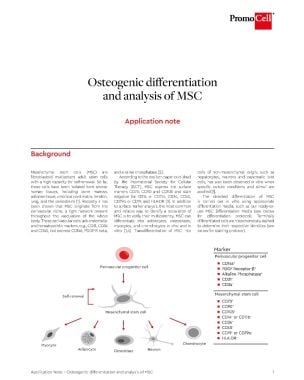
Osteogenic differentiation and analysis of mesenchymal stem cells (MSC)
Differentiate mesenchymal stem cells (MSC) into osteoblasts. Read our application note and find out more. The multipotency of these cells is one essential characteristic of MSC, according to the International Society for Cellular Therapy.
Application Note
Recommended products
