








Raw materials and supply chain management in GMP cell and gene therapies
Raw materials that work well in early development can create unexpected challenges later, from lot-to-lot variability and limited traceability to supply disruptions and additional comparability work. Addressing these risks early can help you maintain process consistency, strengthen regulatory readiness, and avoid costly redevelopment as your cell and gene therapy program advances.
In this interview with RegMedNet, experts Lucía Cespón and Maximilian Gert-Kleint explain how a proactive approach to media selection and raw material management can support a smoother transition toward GMP manufacturing. They explore how RUO/GMP analogue strategies, xeno-free and animal component-free media, robust material qualification, and supply chain planning can help you reduce risk while protecting process continuity.
Read the interview to explore:
- How RUO/GMP analogue media can support comparability and reduce redevelopment
- Why early xeno-free and animal component-free media adoption can simplify later-stage development
- What effective raw material and supplier qualification involves
- How to mitigate supply disruptions and maintain process continuity
- Which storage and handling practices protect material quality through point of use
This material was initially created by RegMedNet and the original version can be found here.
Download the ebook
Fill in the form to download the PDF.
Related resources
Chondrogenic differentiation and analysis of mesenchymal stem cells (MSC)
Managed in vitro differentiation of mesenchymal stem cells (MSC) into chondrocytes. Multipotent adult stem cells are important for various tissues of the musculoskeletal system.
Adipogenic differentiation of mesenchymal stem cells: A complete protocol with Oil Red O staining
Turning mesenchymal stem cells (MSCs) into adipocytes is the focus of this application note, providing a clear and reliable protocol for adipogenic differentiation and analysis.
Xeno-free MSC culture: high yield, better viability and morphology
Are you trying to mimic in vivo conditions in your MSC cultures as closely as possible, but need to avoid serum? Then find out how the combination of PromoCell DXF medium and a unique coating called myMATRIX help you make your conditions highly physiological while maintaining reproducibility.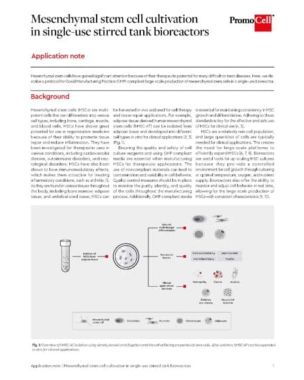
MSC cultivation in single-use stirred tank bioreactors
MSCs have gained significant attention because of their therapeutic potential for many difficult-to-treat diseases. In this app note, we provide a protocol for (GMP) compliant large-scale production of MSCs in a single-use bioreactor using our MSC Growth Medium XF.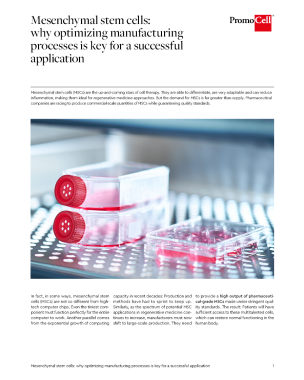
Mesenchymal stem cells: why optimizing manufacturing processes is key for a successful application
Discover the reasons why an optimized manufacturing process is essential for successful application of mesenchymal stem cells.
The immunomodulatory properties of mesenchymal stem cells (MSCs)
Since their discovery in 1991, mesenchymal stem cells, or MSCs, have been used as a promising method to build tissue. However, MSCs can do more for the development of cell and gene therapies. Find out more in our video.
MSC reproducibility: Towards the standardization of Mesenchymal Stem Cells
For science to move forwards, the research we do must be reproducible. One of the ways we’re helping your work be as consistent as possible is through our characterized MSCs.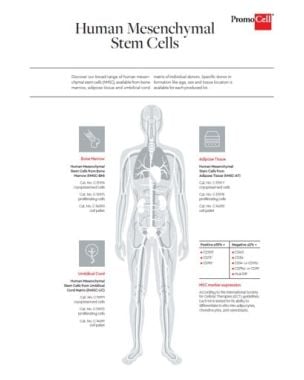
Mesenchymal stem cell types
Discover our broad range of human mesenchymal stem cells (hMSC), available from bone marrow, adipose tissue and umbilical cord matrix of individual donors. Specific donor information like age, sex and tissue location is available for each produced lot.
Characterization of mesenchymal stem cells – why culture conditions and cell identity matter
Learn more about how uniform characterization of MSCs can be applied for improving culture performance and research progress.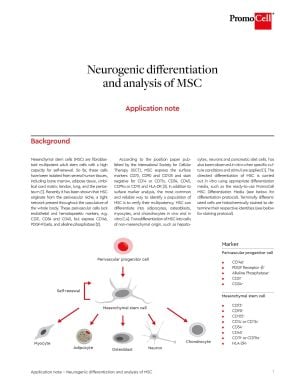
Neurogenic differentiation and analysis of mesenchymal stem cells (MSC)
Specific culture conditions allow for transdifferentiation of mesenchymal stem cells (MSC) into cells of non-mesenchymal origin such as neurons. To do so, specific culture conditions and stimuli are needed.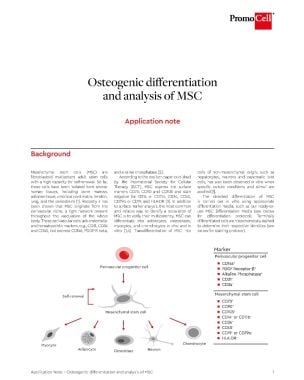
Osteogenic differentiation and analysis of mesenchymal stem cells (MSC)
Differentiate mesenchymal stem cells (MSC) into osteoblasts. Read our application note and find out more. The multipotency of these cells is one essential characteristic of MSC, according to the International Society for Cellular Therapy.Recommended products