
Human primary macrophage culture: cells, media, and reagents from isolation to cryopreservation
At PromoCell, our macrophage portfolio combines characterized human primary macrophages, specialized media, an isolation reagent, a detachment solution, and cryopreservation media, providing a comprehensive set of tools for macrophage research. This integrated approach streamlines key steps for your human macrophage culture and supports standardized macrophage cell culture workflows.
Primary human macrophages present unique challenges in culture because they do not proliferate in vitro. Additionally, macrophages are highly sensitive to variations in differentiation, polarization, culture, harvesting, and recovery conditions, making experimental reproducibility a common challenge. In fast-moving research environments, changing critical components can introduce variability, increase your optimization efforts, and delay your studies. Since every cell preparation is a valuable research resource, we at PromoCell provide reliable cells, media, and reagents designed to consistently support cell recovery, viability, phenotype, and reproducible macrophage culture workflows.
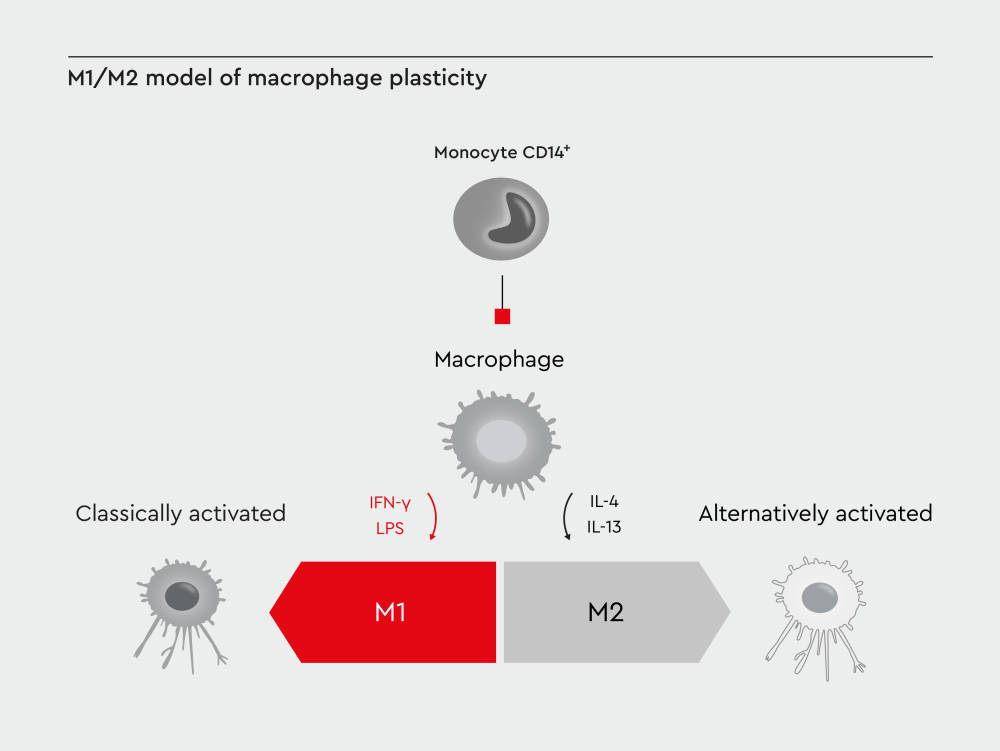
Figure 1: M1/M2 model of macrophage plasticity. Traditionally, macrophages have been classified as M1 (classically activated) and M2 (alternatively activated) macrophages.
Whether you are studying macrophage biology, M1/M2 polarization, macrophage activation, tumor-associated macrophages (TAMs), or drug discovery applications, the portfolio helps reduce your need to source components from multiple suppliers and simplifies workflow standardization.
Contents at a glance
Build a reproducible human primary macrophage workflow
The macrophage portfolio supports an integrated workflow that begins with PBMC isolation and monocyte recovery, followed by differentiation into macrophages and polarization into M1 or M2 phenotypes. You can then perform functional studies, after which you can harvest cells through detachment for downstream analysis or, if required, cryopreserve for future use.
Cells: Ready-to-use Human primary M1 and M2 Macrophages
Human M1/M2 Macrophages (GM-CSF) monocyte-derived are polarized and non-activated cells derived from monocytes. Generating and polarizing primary macrophages in-house requires considerable time on your part, and even small changes in differentiation conditions can introduce variability and affect experimental consistency. Our assay-ready macrophages provide an optimized starting point and are produced using our M1/M2 Macrophage Generation Media XF.
Key benefits
- Access to both M1 and M2 macrophages
- Consistent pre-polarized starting material
- Reduce time required for differentiation and polarization
- Suitable for activation, phagocytosis, and functional studies
Media: Macrophage isolation, differentiation, and culture
At PromoCell, we offer specialized media for both cell isolation and differentiation. Using different media systems for different steps can introduce variability and compromise experimental outcomes, which is why our media are designed to support every stage of your macrophage workflow.
Key benefits
- Efficient isolation of mononuclear cells, including Peripheral Blood Mononuclear Cells (PBMCs) and Bone Marrow Mononuclear Cells (BMMCs), with monocyte recovery using Lymphocyte Separation Medium 1077
- Enhanced adherence selection of monocytes from freshly isolated human mononuclear cells with Monocyte Attachment Medium
- Reliable M1 and M2 macrophage differentiation using M1/M2 Macrophage Generation Medium XF
- Flexible media customization with Macrophage Base Medium XF, a cytokine-free base medium that can be supplemented with your preferred cytokine combinations to create tailored culture conditions
- Optimized xeno-free culture conditions that help improve reproducibility
- Standardized for human primary monocytes and macrophages, with compatibility for murine macrophage applications
Reagent: Macrophage detachment
Macrophage Detachment Solution enables efficient harvesting of adherent macrophages. Macrophages adhere strongly to plastic surfaces, making cell harvesting challenging and potentially resulting in cell loss, reduced viability, or altered phenotype when using non-specialized detachment methods. To help protect your valuable primary macrophage preparations, Macrophage Detachment Solution allows gentle cell harvesting while helping preserve cell quality.
Key benefits
- Designed specifically for macrophages
- Chemically defined formulation
- Gentle enzyme-free cell harvesting
- Helps preserve viability and phenotype
- Supports downstream analysis, including marker validation with flow cytometry, imaging, and functional assays
Cryopreservation: Macrophage cell banking and recovery
Freeze macrophages at any stage of your workflow with Freezing Medium Cryo-SFM Plus. Because macrophages are sensitive cells, cryopreservation can result in reduced viability and loss of valuable cell preparations. Cryo-SFM Plus is designed to support reproducible macrophage cultures across long-term studies by helping you maintain consistent cell stocks and minimizing cell loss after thawing.
Key benefits
- Protein and animal component-free medium with defined composition for consistent results
- Innovative antioxidant-technology supports cell viability, attachment, and growth after thawing
- Minimal freeze damage
- Supports GMP workflows with PromoExQ CellNAP
Human macrophage applications supported by our portfolio
Macrophages play a central role in inflammation, tissue repair, infection, immunology, oncology, and drug discovery. Researchers increasingly need workflows that enable reproducible generation and analysis of M1 and M2 macrophages while minimizing variability between experiments.
Our PromoCell macrophage portfolio supports researchers working across:
- M1/M2 polarization and macrophage activation studies
- Tumor-associated macrophage (TAM) research
- Phagocytosis and macrophage functional assays
- Drug discovery and screening immunomodulatory therapeutics
- Inflammation and infectious disease research
By combining cells, media, isolation reagents, detachment solutions, and cryopreservation media, you can establish a consistent macrophage workflow from sample preparation through final analysis.
Learn more: Essential macrophage experimental set-ups
Access practical protocols and application-focused guidance for two of the most common challenges in macrophage research:
- Differentiation of M1 and M2 macrophages from PBMC-derived monocytes: Learn how to generate and polarize primary human macrophages from freshly isolated PBMC, using an optimized differentiation protocol.
- Isolation of tumor-associated macrophages (TAMs) from fresh tumor tissue: Explore a workflow for isolating TAMs from primary tissue samples of solid tumors.
Whether you are establishing macrophage differentiation workflows, studying macrophage polarization, or investigating TAM biology, these resources provide practical guidance to support reliable and reproducible results.
Need help building your macrophage workflow? Get expert advice on choosing the right macrophage cells, media and regaents for your workflow.