
Make confident animal component-free (ACF) media decisions, from research to GMP
The decisions you make about animal component-free (ACF) media today may shape the success of your GMP strategy tomorrow.
Making the right ACF media and supplier decisions early can help you:
- Maintain process performance and continuity
- Prepare for regulatory and manufacturing requirements
- Protect development timelines and project investments
- Build stakeholder confidence in the path to commercialization
This challenge hub is designed to support cell therapy developers and researchers from discovery through preclinical and clinical development and, where relevant, regulated manufacturing. Explore the scenario that reflects your situation, evaluate practical paths forward, and make your next ACF media decision with greater confidence.
- I can't find an ACF medium that fits my application.
- My current ACF cell culture medium works, but I can't find a GMP version.
- My current ACF medium isn't delivering the performance I need.
- I need a flexible GMP ACF medium with more control over composition.
- I’m concerned about my ACF media’s documentation and future regulatory readiness.
- I'm worried that the ACF medium I choose today won't support future manufacturing requirements.
- ACF media costs are putting pressure on my project.
- Tell us which ACF media challenge is holding you back
1. I can't find an ACF medium that fits my application.
The challenge
For some cell types and applications, including endothelial, skeletal, and fibroblast cell culture, finding a suitable off-the-shelf ACF medium can be difficult. In certain workflows, a medium that meets the necessary performance and application requirements may simply not be available.
What's at stake
When no available ACF medium clearly fits your application, comparing alternatives and deciding which criteria matter most can quickly become overwhelming. Without a clear path forward, development decisions can stall, forcing you to make difficult trade-offs between performance, timelines, and future manufacturing goals.
How to move forward:
Before comparing alternatives, it helps to understand what is preventing existing options from meeting your requirements. Identifying whether the limitation is related to formulation, supplementation, cell-specific requirements, or manufacturing constraints can help focus the evaluation process and reduce the risk of pursuing unsuitable options.
How we help:
When no suitable off-the-shelf option exists, having a viable path forward can make the decision process far less overwhelming.
Rather than forcing you to compromise on critical requirements, customized media can help bridge the gap between your application's needs and future GMP expectations. We adapt media to support your specific cell culture requirements while incorporating ACF formulations and GMP-compliant manufacturing standards, helping you maintain process continuity and move forward with greater confidence.
2. My current ACF cell culture medium works, but I can't find a GMP version.
The challenge
You've already invested time optimizing your process with an ACF medium. Now, as development progresses, you discover that a GMP-grade equivalent isn't available.
What's at stake
Discovering that your ACF medium has no GMP pathway can leave you questioning whether earlier development decisions will create problems later. A media change at this stage may introduce uncertainty around process performance, require additional optimization and comparability work, and make it harder to predict the impact on timelines and future milestones. This can place previous investments under pressure and create concern about maintaining stakeholder confidence.
How to move forward:
Finding that no GMP-grade equivalent is available does not mean your ACF strategy was in vain.
The key is to identify a path forward that maintains the benefits of your current ACF strategy while supporting future manufacturing requirements. Early evaluation of alternative GMP-compatible ACF media or customized formulations that can maintain critical process characteristics would minimize disruption as development progresses.
How we help:
When no GMP-grade version of your current medium exists, knowing there is a viable path forward can help protect the investment in your ACF strategy.
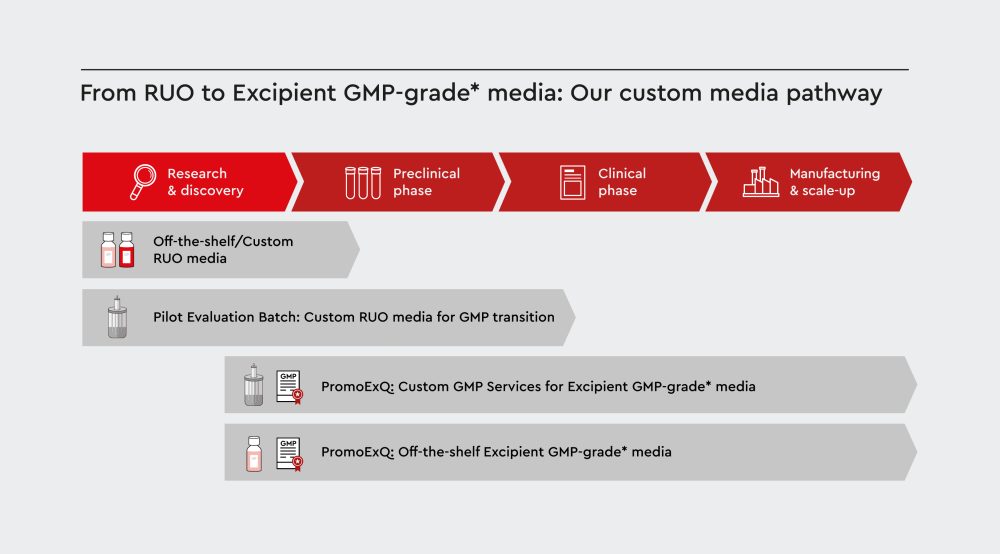
Our ACF media and Custom GMP Services (based on our proven ACF media solutions) provide options that allow you to maintain an ACF strategy while preparing for GMP workflows, helping support process continuity as development progresses.
Our ACF media are entirely free of animal and human components, including animal-derived and human-derived ingredients at the tertiary level. This helps simplify raw material sourcing, reduce supply chain and regulatory concerns, and supports greater consistency as processes scale toward GMP manufacturing.
In addition, our Pilot Evaluation Batch (PEB) program allows you to assess media performance and process compatibility before transitioning to a GMP version. By generating application-specific evidence early, you can better understand potential impacts before scale-up or manufacturing transfer.
3. My current ACF medium isn't delivering the performance I need.
The challenge
Cell growth, morphology, viability, functionality or process consistency may not meet your expectations after transitioning to ACF media.
What's at stake
When the cause of the performance gap is unclear, each adjustment can raise concerns about whether it will solve the problem or introduce new risks. This uncertainty can make it difficult to move forward with confidence. Ongoing performance issues may require additional optimization, delay development, and increase the pressure to find a solution that meets your current needs while supporting your transition to regulated or commercial manufacturing.
How to move forward:

Before moving away from an ACF strategy, identify what is driving the performance gap. The issue may stem from specific formulation characteristics rather than the ACF approach itself. Understanding the underlying cause can help focus optimization efforts and determine whether targeted modification may address the issue while maintaining the benefits of an ACF strategy.
How we help:
When your current ACF medium is not delivering the performance you need, understanding the cause of the gap can help you move forward without abandoning your ACF strategy.
Media customization can help address specific performance limitations while retaining the benefits of an ACF approach.
For teams evaluating GMP-ready ACF media, our Pilot Evaluation Batch (PEB) program allows you to assess performance before broader scale implementation. By generating application-specific data early, it helps identify potential issues before they become larger development challenges, reducing uncertainty around media selection and supporting more informed GMP transition decisions. This can help de-risk GMP transition, reduce redevelopment efforts, and support a smoother path to scale-up.
4. I need a flexible GMP ACF medium with more control over composition.
The challenge
You may rely on proprietary growth factors, cytokines, serum substitutes, lysates, or other process-specific supplements, making it difficult to adopt an off-the-shelf complete medium. In some applications, such as endothelial cell culture, suitable GMP-grade ACF media options are limited and may not provide the flexibility needed for specific workflows.
What's at stake
Without the flexibility to adapt the medium to your application, you may have to compromise on composition or process performance. This can leave you uncertain about whether the chosen medium will continue to support your process as requirements evolve and make it harder to maintain control over the factors that influence future development and long-term success.
How to move forward:
Before selecting a new GMP-ready medium, consider which aspects of your workflow require flexibility. If your process relies on proprietary supplements or other application-specific components, a complete off-the-shelf solution may not always be the best fit. Understanding which elements need to remain under your control can help guide the selection of an ACF media strategy that supports both your process requirements and future GMP goals.
How we help:
When maintaining control over media composition is critical, flexibility becomes just as important as GMP readiness.
We can customize Excipient GMP-grade ACF base media to fit your specific application needs. This allows you to continue using proprietary supplements while retaining greater control over media composition.
For teams evaluating a new ACF media solution, our Pilot Evaluation Batch (PEB) program allows you to assess performance before moving forward with a GMP-grade solution. By generating application-specific data early, you can better understand how a new media strategy fits your workflow and make informed decisions before moving to larger-scale implementation.
5. I'm concerned about my ACF media's documentation and future regulatory readiness.
The challenge
Choosing an ACF medium can help address concerns associated with animal-derived raw materials, but future clinical applications and commercial manufacturing involve more than selecting an ACF formulation. For applications progressing toward clinical manufacturing, not all ACF media offer the same level of regulatory support, such as documentation and raw material traceability. Differences that seem minor today can become significant later in development.
What's at stake
Incomplete documentation, traceability, or supplier support can make it difficult to know whether every critical GMP requirement has been addressed. Discovering gaps later can trigger additional reviews, extend development timelines, increase costs, delay manufacturing readiness, and create pressure to explain and justify decisions that previously appeared sufficient.
How to move forward:
Planning your media strategy ahead can help you avoid future delays. Choose an ACF medium that supports future GMP readiness from the early research stage.
Review documentation packages, raw material traceability, supplier quality systems, and manufacturing standards early to identify potential gaps before they become larger challenges.
How we help:
If you're unsure whether your current media strategy provides the documentation needed for future clinical applications or commercial manufacturing, our team can help you review your requirements and identify potential gaps early. With our ACF GMP media, we provide the comprehensive documentation and quality support you need for audits, risk assessments, internal reviews, regulatory planning, and regulatory approvals.
Our ACF media are entirely free of animal and human components, including animal-derived and human-derived ingredients at the tertiary level. This helps simplify raw material sourcing, reduce potential supply chain and regulatory concerns, and supports greater consistency as your application advances toward clinical or regulated manufacturing stages.
Together, our comprehensive documentation supports a well-designed ACF media strategy that can help you prepare for future regulatory requirements with fewer surprises along the way.
6. I'm worried that the ACF medium I choose today won't support future manufacturing requirements.
The challenge
Moving from development to larger-scale media manufacturing involves significant financial and operational risk. Selecting a medium based only on current development needs can create challenges later if manufacturing, supply, or regulatory requirements aren‘t considered early.
What's at stake
Waiting until later stages to assess media for manufacturing and regulatory readiness can lead to additional optimization work, process changes, or delays during technology transfer. As future requirements across the value chain become clearer, teams may find themselves reassessing earlier decisions and investing additional time and resources to address avoidable gaps. This can increase pressure on your team, extend development timelines, require additional resources, and put commercialization goals at risk.
How to move forward:
Before finalizing an ACF media strategy, evaluate whether the medium and its supply model can support future manufacturing requirements. Understanding how factors such as scalability, raw material sourcing, supply continuity, and regulatory expectations may affect future development can help identify potential gaps early and support decisions that align with both current process needs and long-term manufacturing goals.
How we help:
The challenge isn't just finding a medium that works today. It's choosing a strategy that will continue to support your process as manufacturing requirements evolve.
- Media that are completely animal component-free, including animal-free recombinant components, can help simplify sourcing strategies and support greater consistency as manufacturing demands increase. By reducing dependence on animal-derived raw materials and derivatives, they can support a more scalable manufacturing approach and minimize the likelihood of future media changes.
- When standard formulations do not fully align with manufacturing objectives, our customized ACF media with Custom GMP Services can help adapt proven PromoCell formulations to specific process and manufacturing requirements.
- Our Pilot Evaluation Batch (PEB) program allows you to evaluate customized ACF media formulations, assess process compatibility, and generate process-relevant data before transitioning to GMP media and scale-up.
7. ACF media costs are putting pressure on my project.
The challenge
Balancing budget constraints with performance, scalability, and future regulatory requirements is difficult. At the same time, investing significant time and resources into a new GMP-grade ACF medium can feel risky before you've evaluated its performance in your application.
What's at stake
When immediate budget pressure competes with long-term development needs, it can be difficult to know which option offers the best overall value. A medium with lower upfront cost may feel like the safer choice. However, if it increases variability, requires extensive supplementation, or forces a later process change, it can create additional work and uncertainty while ultimately increasing total project costs.
How to move forward:
Before comparing media options based on cost alone, consider the broader impact each option may have across the product lifecycle. A lower purchase price does not always translate into lower overall project costs. Process performance, supplementation requirements, scalability, GMP readiness, and the need for future optimization or process changes can all affect resource demands, timelines, and long-term project success. Evaluating these factors early can help determine which option delivers the best overall value while minimizing avoidable redevelopment work later.
How we help:
When budget pressure is high, confidence in the decision often becomes just as important as the cost itself.
If existing ACF media options don’t provide the right balance of performance and cost, our Custom GMP Services can be used to adapt formulations to specific process requirements and development goals.
Our Pilot Evaluation Batch (PEB) program allows you to assess ACF media performance before making GMP manufacturing commitments. By evaluating performance in your own application, you can generate evidence to support investment decisions and reduce the risk of committing significant resources that may require costly rework later on.
Not sure which path is right for your ACF media strategy?
Tell us what’s creating uncertainty in your process. Our GMP expert team will review your submission and reach out to you to discuss your situation and help identify a practical next step.