
Immune cell therapies are reshaping oncology. Yet turning promising research into clinical success remains difficult. As these therapies advance into complex solid tumors, researchers need models that capture tumor-immune biology more accurately and generate meaningful, reproducible data.
To help researchers tackle these challenges, we partnered with RegMedNet on an In Focus feature about preclinical model design for immune cell therapy. The feature explores how to build more relevant tumor models, choose meaningful functional readouts, and reduce experimental variability. It also highlights emerging approaches that may improve translational success.
Infographic
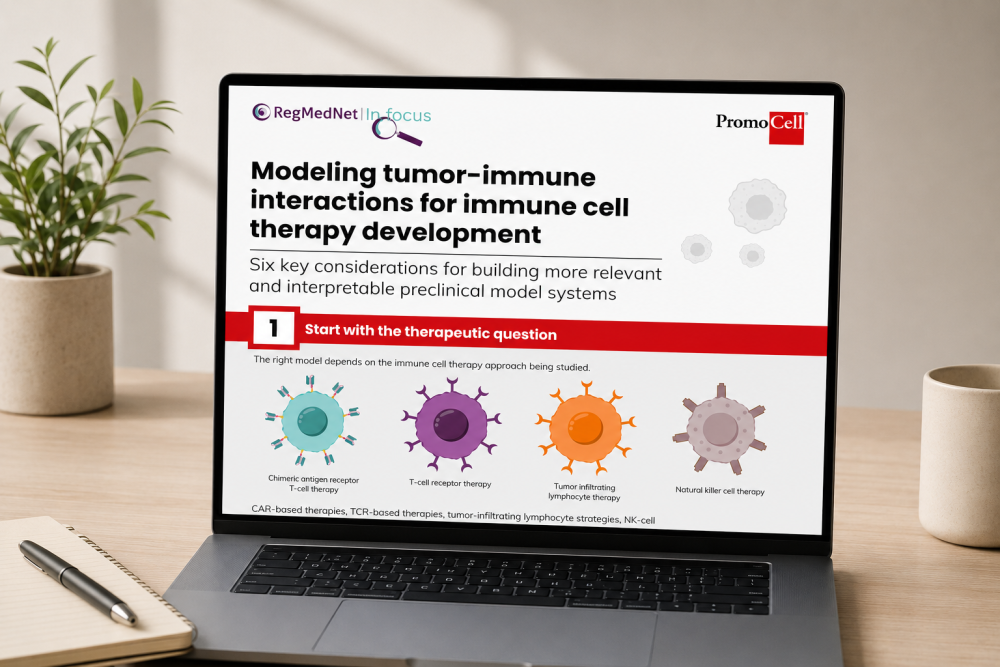
The feature includes a downloadable infographic that outlines six key considerations for creating more relevant and interpretable preclinical immune cell therapy models. It gives researchers a practical framework for assessing tumor-immune interactions and improving experimental workflows.
From the infographic, you’ll learn how to:
- Match model systems to the therapeutic question and mechanism of action
- Pick the right complexity, from 2D assays to 3D immune-tumor co-cultures
- Include key tumor microenvironment components to study immune behavior
- Factor in donor variability and HLA context
- Use readouts that capture immune activity beyond tumor killing
- Reduce avoidable variability
Expert interview
What does it take to design model systems that generate data researchers can trust?
In an exclusive interview, our experts Alexander Trampe (Dr. rer. nat.), Janina Moros (MSc), and Zinnia Noor (Dr. rer. nat.) discuss how preclinical models are evolving to address the unique challenges of immune cell therapy development. The discussion explores why simplified systems often fall short, how advanced 3D models can provide greater biological relevance, and what researchers can do today to improve the interpretability of their results.
What you'll learn from the interview:
- Sources of variability in stem cell culture systems and how you can mitigate them.
- Where simplified assays fall short in modeling the tumor microenvironment
- How 3D models and immune-tumor co-cultures generate more relevant data
- Which immune cell populations add biological context
- When donor characterization and HLA typing are critical
- How to choose readouts that reflect mechanism of action and immune response
- How to reduce variability through standardization and robust reporting
- What emerging platforms may improve translational relevance
This interview was made in collaboration with RegMedNet.
Access the full feature Discover expert insights and practical guidance for designing more predictive, reproducible, and biologically relevant preclinical models for immune cell therapy development.